Kasama – a not-so-relaxed day in the Rätikon

After a weekend spent working, I was fairly tired and had reserved Monday for a day of climbing. Walter was free as well, so I suggested something on limestone in the Rätikon — an area I know well and return to often. There was one route I had never climbed: Kasama, about 5 pitches on the more northerly side of the Schweizereck. On paper it looked a little less demanding than some of its neighbours. Not exactly a plaisir route, perhaps, but I was hoping for a day without too many grey hairs.
A relaxed start
We started at a very civilised hour on a beautiful morning. For some time now I have liked using the mountain bike to reach the alp below the walls, and with light packs the approach went quickly. A few teams were already climbing nearby routes, including Intifada and Lilith, both of which I had climbed in previous years. We continued a little farther to the start of Kasama. The bolts and hangers looked decidedly old-school, but still solid, and the limestone was perfect.
So much for plaisir climbing
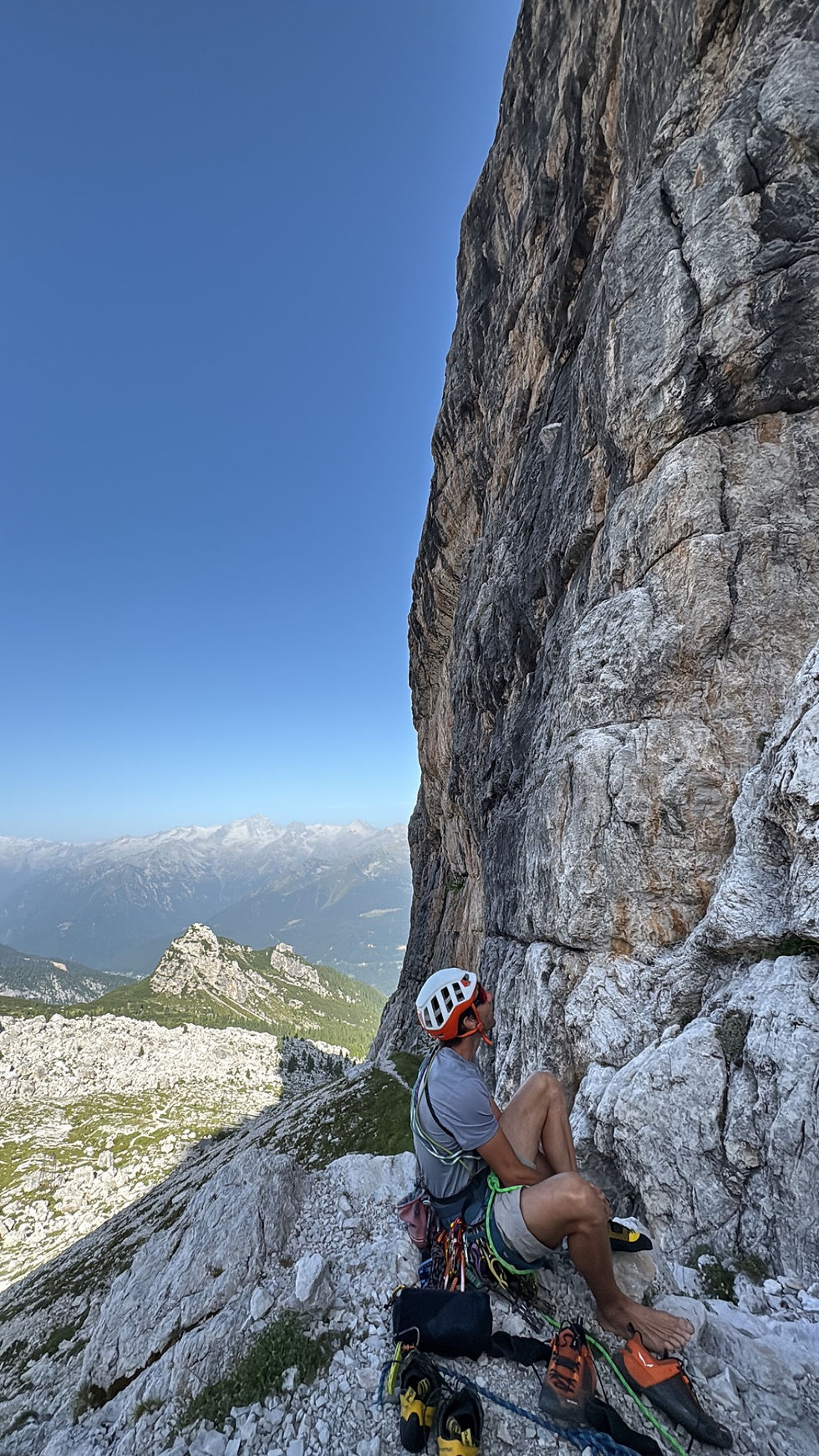
The first surprise was the wind. It was brutally cold. I knew that the Schweizereck can be very windy, but our plan of starting in relaxed plaisir mode disappeared immediately. The first pitch, graded VII+ in the guidebook, was already a proper Rätikon wake-up call. Beautiful climbing, and no particular problems, but enough to make it clear that this was not going to be the easy recovery day I had imagined.
Walter took the easier transfer pitch while I happily kept my approach shoes on and my feet warm. Then came another VII+: more athletic, very good climbing, and the first unmistakable signs that other parties had also had second thoughts here. An abandoned carabiner appeared on the route — and shortly afterwards the protection disappeared.
A real runout followed while overcoming a roof. From below the next bolt was invisible and the line was far from obvious. Fortunately, after a few metres a bolt finally appeared, protecting another long traverse of perhaps six or seven metres. Without it, a fall would have meant a very impressive flight into space. Classic Rätikon: the guidebook may say that a pitch is well protected, but the wall still gets the final word.
The slabs
The real business, however, was still above us: the two hardest pitches, both given VIII- on the topo. These are markedly different from the more sculpted limestone found on routes such as Intifada. Here the wall is the classic pale-grey Rätikon slab: vertical, smooth, compact and with very little that can honestly be called a hold.
I arrived at the crux after already solving one wonderfully improbable sequence — the sort of move where the numbers seem to stop making sense and a foot ends up almost at shoulder height before you can somehow stand up on it. Then another blank section, another delicate mantle, and more of that wonderful combination of friction, balance and commitment that makes Rätikon slabs so distinctive.
The final hard pitch is thinner and even more slabby, although for me it felt a little less extreme than the previous one. One thing is worth saying clearly: whatever obligatory grade one reads in a guidebook, there is very little possibility of avoiding the difficult climbing on these upper slabs. The protection is good where it matters, but you still have to climb between the bolts.
Worth it?
Kasama perhaps does not have quite the uninterrupted elegance of some of the great classics nearby Intifada or Lilith (this latter share the same route setter Michi Wyser). A small grassy ledge and broken band interrupt the continuity of the wall. But the rock on the first pitches and especially on the final two is exceptional — genuinely five-star limestone. The bolting is good, even if there are sections where the distances and route-finding keep things very much in Rätikon territory. Keep in mind that the obligatory match the difficulty (~VIII). The slabs felt hard to me, at least similar to what you find in the slab pitch of Schweizerzoo, just 50 m on the right.
For the descent there is not much to report: three very quick rappels, with the alternative of walking down. We simply abseiled, collected the bikes and stopped briefly at the stream where we normally cool off with a quick dip. This time everything was completely dry, so there was no bath. We rolled rapidly back to the car and by around 15:30 I was practically home.
From the point of view of efficiency, it was an almost perfect day. From the point of view of my original plan — something quiet and easy after a tiring weekend — perhaps slightly less so. Then again, going to the Rätikon in search of an easy, relaxing day may have been the first mistake.
Interested in a first approach to Ratikon with a local guide? Contact me for a personalised offer!


Comments