Alimonta–Vidi on Castelletto Inferiore – Racing the Afternoon Storms

Updated: Aug 27
We started early, knowing that the weather window would be limited. This summer in the Brenta had been dominated by the same pattern again and again: clear mornings, heat building quickly, and thunderstorms in the afternoon.
We had two options. We could stay lower and choose something closer, or head up towards the Tuckett area. My brother was keen to climb there, so the decision was made: we would go to Tuckett and accept the race against the weather.
The route was the Alimonta–Vidi on Castelletto Inferiore, a wall packed with history. The Castelletto has many famous classic lines as well as more modern routes, and over the years I had already climbed quite a few of them.

I remembered only the final two pitches of this route. I had climbed them when I was nineteen, coming across from the better-known Kiene route next door, which is easier. The Alimonta–Vidi itself is more sustained, with many pitches around UIAA V and V+, and sections approaching VI-.
Old pitons, good rock, and a hammer
After another breakfast at Rifugio Tuckett we got ready and walked to the wall. The first pitch immediately reminded me of one of the basic rules of climbing in the Dolomites: bring a hammer. A few old pitons were already working their way out of the rock, so I gave them some attention before moving on.
The first section of VI− went without much drama. The next pitch was again beautiful climbing on relatively compact rock, followed by a much less interesting sixty-metre transfer across broken terrain and scree. That brought us beneath the real heart of the wall.

From there the climbing stayed consistently enjoyable. The rock was generally good, with only occasional sections requiring a little more care. There were not many pitons, but the cracks took protection well, so it was easy enough to supplement the old fixed gear with cams and nuts.
Route-finding was not always completely obvious. The face is very structured, full of corners, grooves and ledges, and at times there are several plausible ways through. Still, we kept finding the line and moved quickly.
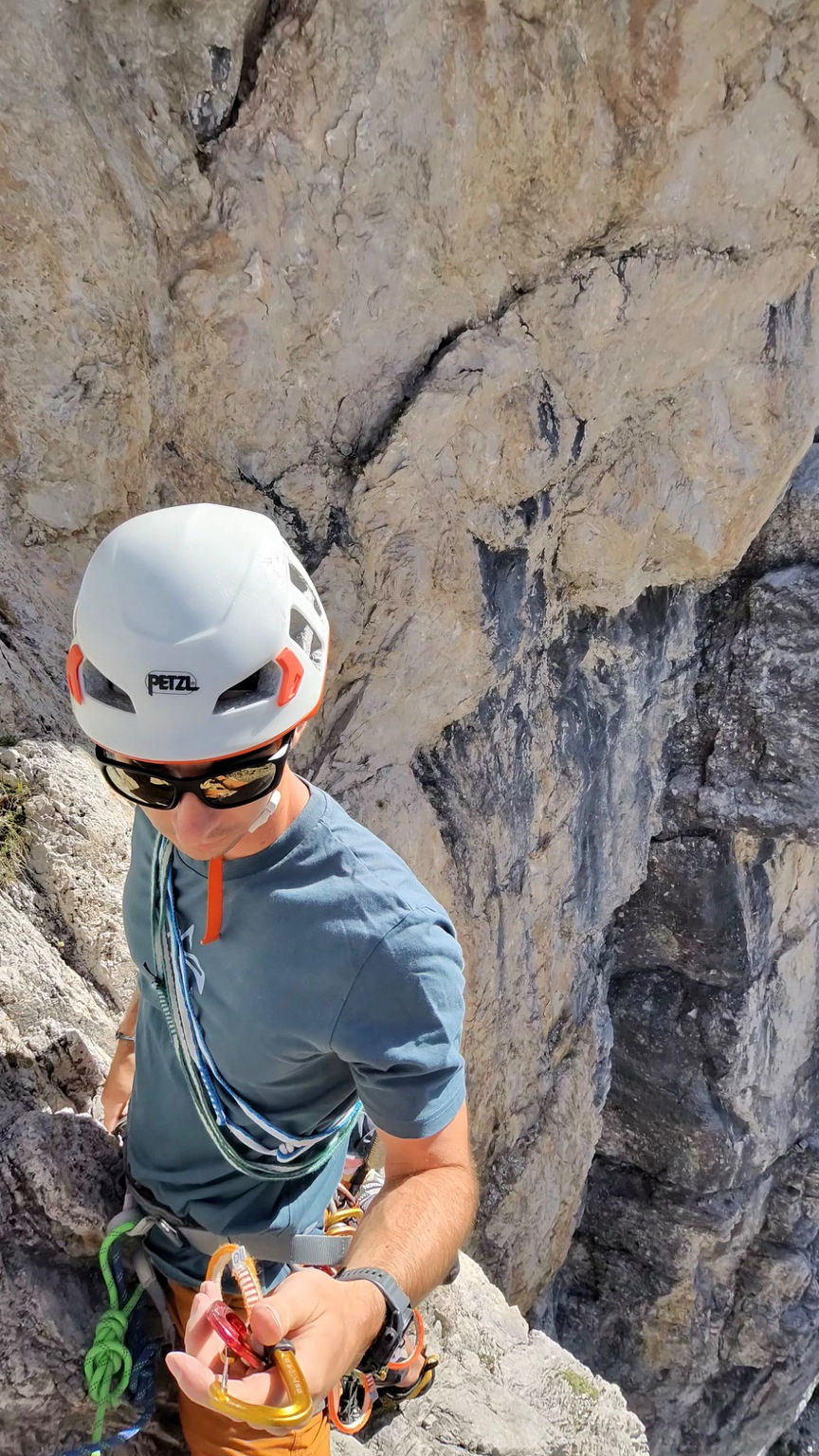
It was also brutally hot. For much of the route we climbed bare-chested, happy whenever a bit of shade finally reached the wall.
The pitch I remembered differently
Eventually we reached the final two pitches. This was the part I remembered from when I was nineteen. I looked up and thought: yes, I know this one. It is well protected. No problem.
Memory, apparently, is generous.
Over roughly twenty to twenty-five metres of slightly overhanging V+ climbing, I found only three pitons. None of them inspired much confidence. The climbing itself was manageable, but hanging above old, tired gear on terrain that is not exactly easy gave the pitch a very different character from what I had remembered.

Still, the pitch went, and soon after I reached the top and watched my brother climb up behind me.
Thunder on the descent
And then the thunder started.
A little earlier, a mountain guide with two clients had passed us after climbing the Gasperi edge, essentially the normal route. My first thought was that we might now end up in a queue on the descent.
Fortunately, another rappel line had been prepared. I spoke with the guide and he confirmed that the rappels were around thirty-five metres, which meant our ropes were perfect for the job.

We dropped fast. At the bottom of the first rappel the storm looked increasingly serious. Lightning was flashing behind us, perhaps a kilometre away. There was no discussion: rope down, pull, reset, again. Two quick rappels and we were back on the ground.
We packed everything and started down towards the valley as fast as possible.
In the end, the storm turned out to be almost theatrical. It rained everywhere around us, but somehow not where we were. We had been lucky.
And the timing had actually been good. We reached the top at around 1:30 p.m., roughly four and a half to five hours after starting the route. Fast enough for a summer day when the sky is always part of the decision-making.
Back at Rifugio Tuckett, the day ended in the best possible way: with food, dry clothes, and the satisfaction of having fitted a beautiful Dolomite route neatly inside a narrow weather window.
Interested in similar climbs in the Dolomites and Adamello?


Comments