Carè Alto – The Garbari Ridge

Updated: Aug 22
There are mountains you admire from afar, and mountains you gradually get to know. Carè Alto belongs firmly to the second category for me. Of all the peaks in the Adamello–Presanella group, it is the mountain whose rock I love most: compact, rough granite shaped into cracks, corners and exposed ridges that invite elegant movement rather than brute force.
Four classic ridges converge on its summit, each revealing a different side of the mountain. Over the years I had already climbed the other three. The Southeast Ridge—the Garbari—was the final one still missing.

A three o’clock start
The alarm rang at three in the morning. Francesca and I rose from our beds at Rifugio Carè Alto like two zombies, after the long approach from Pian della Sega in Val di Borzago the previous afternoon. Thanks to the kindness of the hut keeper, part of the rope and hardware had travelled up by cableway. The rest had come with us, as usual, on our backs.
The evening had brought an unexpected surprise: Carlo, who had completed the aspirant mountain-guide course with me, and my friend Jacopo were also at the hut. They had chosen the same rarely repeated ridge. By four o’clock, after a quick breakfast, the four of us were moving into the dark.

I knew the first part of the approach from two previous ascents of the Cerana Ridge. Beyond the Bocchetta del Cannone, however, we left the familiar line and traversed towards the base of the Garbari. The rusting remains of a First World War artillery piece lie among the granite blocks there—an improbable object in such a remote place, and a reminder that these mountains have carried far more than climbers.
From a distance, the broad slabs guarding the ridge looked almost impassable. Up close, a continuous maze of ledges and weaknesses appeared, leading diagonally towards the col where the climbing begins. We found the start almost by accident and formed two rope teams, Carlo and Jacopo ahead, Francesca and me behind.
The crux in mountain boots
There are many pitches on the ridge, so efficiency matters. We alternated between pitching, short-roping and protected moving together, adapting constantly to the ground. I used a Micro Traxion to manage Francesca as second on some of the longer pitches—an efficient system, provided the rope is kept attentive and no slack is allowed to build.
The famous fifth-plus pitch arrived early. The corner was beautiful, but it ended with two or three metres of smooth granite that felt remarkably serious in mountaineering boots. I immediately regretted leaving my climbing shoes at the hut. The protection was not especially reassuring either: one old piton seemed ready to come out by hand, while the hammer was, naturally, buried in the pack below.
Once past those first difficulties, the ridge became a magnificent granite journey. Carè Alto never ceases to surprise me with the quality of its rock. Cracks accept protection naturally, corners lead from one tower to the next, and even the easier passages reward precise, balanced movement.
After four or five hours we reached the final major obstacle. At first I could not reconcile the terrain with our description; the wall above looked blank and improbable. Only after comparing it carefully with another account did we identify the exposed weakness. It was the last real key passage and another moment when a light pair of climbing shoes would have been welcome.

The fourth ridge
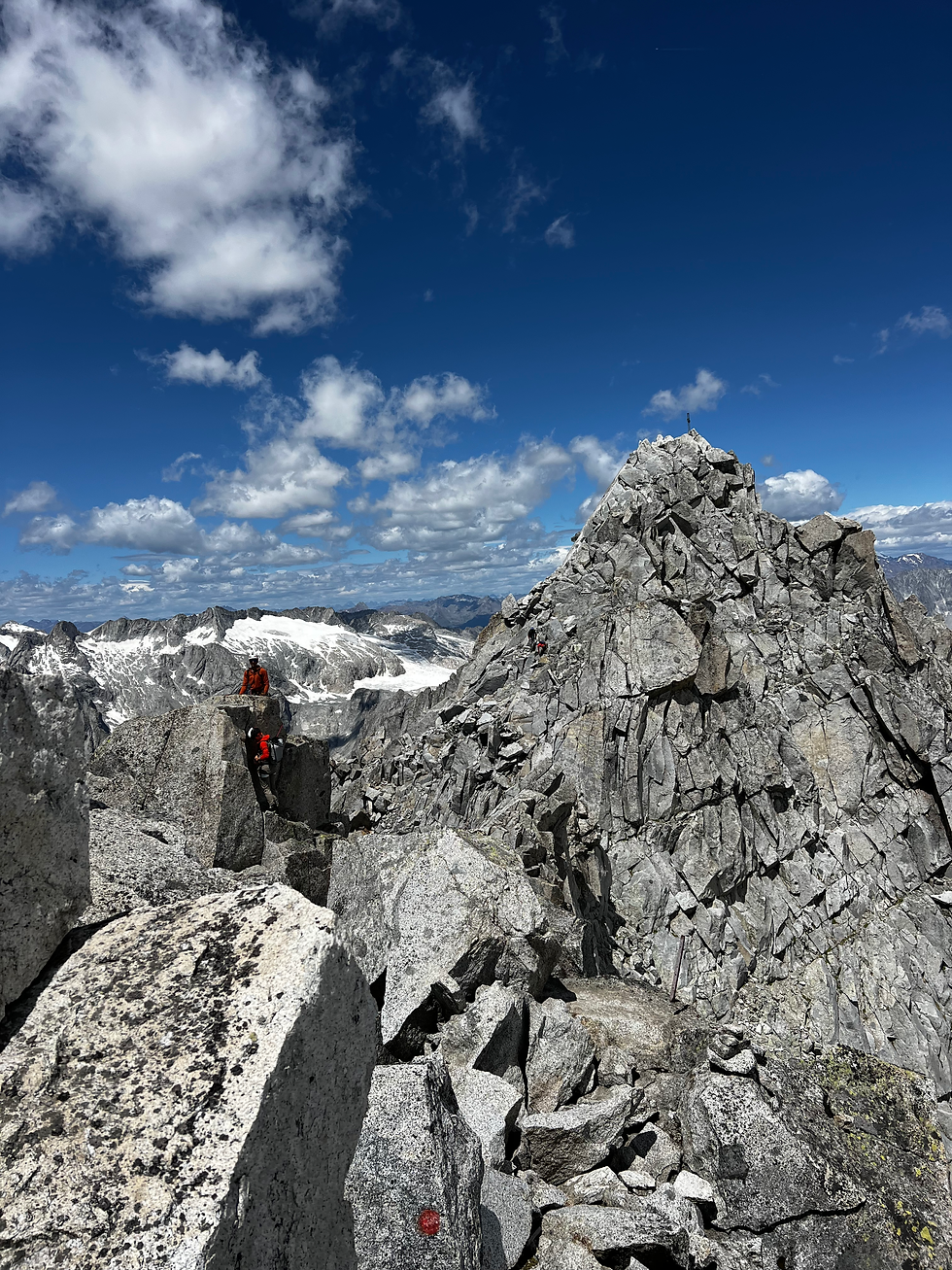
Soon afterwards the Garbari merged with the upper ridge and carried us to the summit of Carè Alto. I looked across at the Jäger Ridge, another historic line that seems to follow the mountain with fewer technical difficulties but an even longer approach recently rebolted. It will probably provide the excuse for my next visit.

The Cerana descent
We chose to descend by the Cerana, the east ridge, avoiding the glacier route. It is faster, but it is not simple. The ridge drops through exposed steps and traverses, and I often belayed Francesca across the more awkward sections. After the distinctive schiena di mulo passage, we reached the abseils.
The ropes jammed on the first pull. I climbed back up, released them and descended again. They jammed once more at the next abseil. Up again, free the rope, down again. By the time we finally stepped onto the glacier it was four in the afternoon.
Then came the kind of downhill run that makes tired legs feel light. In less than an hour we were back at the refuge, drinking something cold, eating a sandwich and repacking for the long descent to the valley. Carlo had carried a paraglider, hoping to finish the day through the air. The wind had other plans, and the wing went back into the pack.
What makes the Garbari memorable is not a single hard move. It is the complete journey: the long approach, the wartime cannon, hours of moving together over exceptional granite, uncertainty in the route finding, the technical descent and the final walk home. Some mountains are remembered for their summit. Carè Alto is remembered for the whole day.
Guide’s Notes
Route: Southeast Ridge (Garbari), descending by the Cerana Ridge.
Difficulty: A long alpine ridge requiring confident route finding, efficient movement over exposed terrain and the ability to switch naturally between pitched climbing and moving together.
Equipment: A single 60 m rope is ideal for the climb and descent. Carry a light rack with a few extra small-to-medium cams. A lightweight pair of climbing shoes makes the crux considerably more enjoyable than mountaineering boots. We found no real use for the hammer.
Best season: Early to mid-summer, once the approach and descent are in stable condition.
What makes it special: Outstanding Adamello granite, elegant climbing and a wonderfully isolated setting. Linking the Garbari with the Cerana turns the route into a complete traverse of the mountain.
For the detailed route description, we followed the account published by PlanetMountain: https://www.planetmountain.com/it/itinerari/care-alto-cresta-sudest-care-alto.html
Interested in exploring the classic granite ridges of the Adamello–Presanella? Feel free to get in touch.


Comments